Lead Service Lines in Florida: Inventories, Letters and Replacement
A letter saying your Florida water service line is unknown, galvanized, or possibly lead can leave you unsure what to do next. The inventory and replacement process has set deadlines, but a status label is not always a final answer about the pipe serving your home. Here’s how to find the right utility, interpret its records, ask for verification, and understand what replacement planning means.
What a lead service line is and why the inventory matters
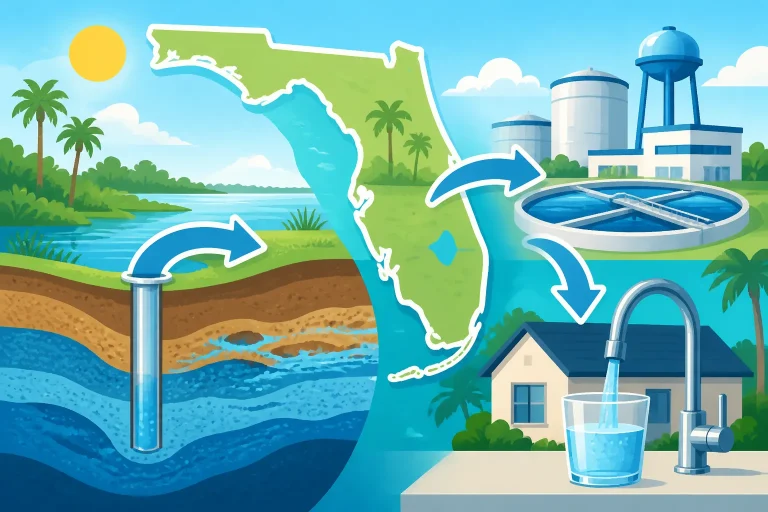
A service line is the pipe that carries water between a utility’s water main and a building. It may include a section on utility property and another section on private property, though the exact layout and ownership responsibilities can vary. A lead service line is one made of lead. Galvanized pipe is steel or iron pipe coated with zinc; if it previously carried water through lead pipe, lead may have accumulated on its interior. The way a utility classifies a galvanized line can therefore matter, not just the material visible at a particular point.
The service line is only one possible source of lead in household water. Plumbing inside a building, fittings and other components may also affect water at the tap. A utility inventory describes the service line records it has assembled; it does not test every faucet or establish that all water reaching a home is free of lead. For that reason, a clean or non-lead service-line classification should not be treated as a guarantee about every part of a property’s plumbing.
The inventory requirement is about documenting the service lines connected to a public water system. According to the Florida Department of Environmental Protection, the LCRR requires all community and non-transient non-community public water systems to inventory all service lines. That broad inventory is meant to identify known materials and gaps in the available records, rather than look only for pipes already confirmed to be lead.
An inventory can help a utility decide what to investigate, communicate with customers, and include in its replacement planning. It can also help a resident understand what the utility knows about the line serving a particular address. But the inventory is not necessarily a complete physical inspection. Utilities may have to rely on records, past work orders, construction information, customer reports, or observations made during repairs. The level of certainty can differ from one address to another.
That is why the label attached to a property matters. A line recorded as lead is different from a line recorded as non-lead, and both differ from a line whose material is still unknown. A “galvanized requiring replacement” designation is also distinct from an ordinary galvanized classification. The exact definitions and labels used in a specific inventory are best checked against that utility’s explanation. For a closer look at the categories, see Lead, Galvanized or Unknown: Florida’s Service Line Inventory Labels.
It is useful to separate three questions that are often blurred together:
- What material does the utility’s record assign to the service line? This is an inventory question.
- How certain is that record? This is a verification question.
- What does the record mean for future work or household steps? This is a planning and action question.
An inventory entry can answer the first question while leaving the other two open. For example, a “lead” entry identifies a known concern, but it does not necessarily tell you when work at your address will occur. An “unknown” entry does not confirm that the pipe is lead, but it does mean the utility has not established the material in its records. A replacement plan may outline how a system expects to address its lead and galvanized requiring replacement lines, but the plan itself does not prove that a specific line has already been replaced.
Residents can use the inventory as a starting point, not as the only source of information about their home. If you have an older property, a renovation history, or visible pipe material that appears inconsistent with the utility’s record, ask how the utility reached its classification and what it would accept as additional evidence. If the concern is lead at the tap, service-line records and tap-water testing answer different questions. The distinction is discussed in Does a Florida Water Quality Report Describe the Water at Your Tap? and Will a Water Test Show Whether a Florida Home Has Lead Pipes?.
Florida’s inventory, notification and replacement deadlines
Florida systems had a deadline to submit their initial inventories. According to the Florida Department of Environmental Protection, initial lead service line inventories were due no later than October 16, 2024. The agency also states that water systems had to submit their initial lead service line inventory by October 16, 2024. These are system obligations; they do not mean every utility submitted on time or that every address has a verified material classification.
A resident who cannot find an inventory should not assume that the system has no lead lines. Start by asking the water provider where its inventory is available and whether it has an address lookup or customer-specific status. If the provider cannot immediately locate your property record, ask whether the system’s service-area boundary or a separate water provider could explain the mismatch. How to Confirm Which Water Provider Serves a Florida Address can help when the provider is not obvious from a mailing address or city name.
The inventory also triggers a customer-notification requirement. The Florida Department of Environmental Protection states: Within 30 days of completion of the Initial Lead Service Line Inventory, water systems must notify customers of known or potential lead service lines. A letter or notice may therefore give a customer the system’s current classification, explain that the material is uncertain, or provide directions for checking the record. The required timing is tied to completion of the initial inventory, not necessarily to the date a resident first sees a notice.
A customer letter is important, but it is not a substitute for reading the underlying status carefully. Pay attention to the property address, the exact material category, whether the record covers the utility side, the property side, or both, and whether the utility describes the finding as confirmed or uncertain. If a letter gives a general service-area warning rather than a property-specific result, ask whether there is a separate record for your address.
Replacement planning has its own deadline. According to the Florida Department of Environmental Protection, water systems must submit a service line replacement plan for lead or galvanized requiring replacement service lines by November 1, 2027. A plan is a system-level document. It can describe how the utility expects to organize replacement work, but the date for submitting a plan is not the same as a promise that any particular home’s line will be replaced by that date.
The replacement deadline is later. According to the Florida Department of Environmental Protection, water systems must fully replace all lead and galvanized requiring replacement service lines by November 1, 2037. That requirement describes the system’s full-replacement obligation. It does not mean that every utility will schedule each property at the same time, or that a resident should wait for a future replacement if the utility has identified a current lead line and provided specific advice.
| Milestone | What it means for a resident |
|---|---|
| Initial inventory due no later than October 16, 2024 | Ask the utility where its inventory is posted or how to obtain the entry for your address. |
| Customer notice within 30 days of completion of the initial inventory | Read the material classification and ask whether it is confirmed, potential, or still unknown. |
| Replacement plan due by November 1, 2027 | The system must submit a plan for lead or galvanized requiring replacement lines; this is not an individual property appointment. |
| Full replacement by November 1, 2037 | The system must fully replace all lead and galvanized requiring replacement service lines. Ask how the system’s schedule applies to your address. |
A deadline tells you what a system must do by a certain point; it does not answer every local scheduling question. Residents should check the current information from their own utility because inventories, customer notices, and work schedules are specific to the provider. For more on how the deadline and plan fit together, see Florida Lead Line Deadlines for Replacement Plans and Full Replacement.
How to find your record and read the status
Begin with the utility that supplies water to the property, not necessarily the city printed on the mailing address. Florida homes can sit outside municipal boundaries, and some providers serve areas that do not match the city name residents use. A landlord, homeowners association, or property manager may know the provider, but the official utility is the place to confirm a service-line record.
Look for the utility’s lead service line inventory or customer notice. Some systems may offer a searchable address tool; others may provide a map, downloadable record, or a way to request information. If there is no obvious public lookup, contact the utility through its official website and ask for the inventory classification tied to the service address. Provide the full street address and, if available, the customer or account identifier. Avoid posting account information publicly.
When you find the entry, take note of the material label and the scope of the record. A record may distinguish between the utility-owned portion and the customer-owned portion. It may also indicate that one portion is known while another is unknown. The meter, curb, property boundary, or other landmark might help explain the sections, but do not assume that a visible dividing point establishes ownership. Utility records and local arrangements govern how the system describes the line. The distinction is covered in Does a Florida Lead Line Inventory Cover Both Sides of the Meter?.
What common labels can and cannot tell you
A lead classification indicates that the relevant section is recorded as lead. Ask whether this applies to the whole service line or only one section, and what evidence supports the designation. A lead label is not the same thing as a tap-water test result; it identifies pipe material in the service-line record.
A non-lead classification means the inventory does not identify that section as lead. It does not establish the material of plumbing inside the home, and it does not rule out other possible lead sources. If your house has older plumbing or you are concerned about tap water, consider the separate question of testing and consult the utility about its lead guidance.
A galvanized classification may need more context. Ask whether the utility considers it galvanized requiring replacement, and whether records indicate that the line was ever connected to lead pipe. Do not assume that every galvanized line has the same classification or that a generic galvanized label automatically answers replacement eligibility.
An unknown classification means the utility has not established the material in its records. It is not proof that the line is lead, but it is also not confirmation that the line is non-lead. Ask what additional information could resolve the status, whether the utility expects to investigate it, and whether a customer can submit photos or other documentation. Your Florida Utility Lists Your Pipe as Unknown: How to Verify It focuses on those follow-up steps.
If the utility’s label is unfamiliar, request the system’s definitions in writing. Terms can be easy to misread when a map uses abbreviations or when an online tool separates the property-side and utility-side sections. Ask whether the displayed status is based on a physical observation, a record, or an unresolved assumption. A useful record should make clear which part of the line the label describes.
Keep a copy of the notice and any responses. Save the date you checked the inventory, the exact status shown, and the name or department of the utility contact. If the inventory changes later, having the earlier entry helps you understand whether the utility corrected a record, completed an investigation, or updated the classification after work.
When the record appears wrong or incomplete
A mismatch can happen for practical reasons: a record may refer to the wrong address, may not show both sections of the line, or may rely on incomplete historical information. If you see a mismatch, ask the utility to review the service address and the underlying data. State what appears inconsistent and provide any supporting material the utility says it can use.
Photographs can be useful if the utility requests them, but a photo of a short exposed segment may not establish the material of the full service line. Take photos only where the pipe is safely visible and accessible; do not dig, cut, or disturb plumbing to identify a material. Ask the utility what angles, landmarks, or documentation would make the photos useful. Identifying Your Service Line Material in Florida, and Photos to Send offers more detail on what to document.
If your service line has been repaired or replaced in the past, provide the approximate work history and any paperwork you have. A plumbing invoice, permit record, or utility work notice may help, but the utility should explain what it needs to change its official entry. A customer’s observation can prompt a review without necessarily being enough, by itself, to revise a system inventory.
What to do when a utility letter arrives
A lead-service-line notice can be alarming, especially if it uses words such as “potential” or “unknown.” Read it slowly and separate what it confirms from what it recommends. The letter may give a property-specific classification, explain a system-wide issue, describe a planned investigation, or provide household steps while a line remains unverified. These are different kinds of information.
First, confirm the notice is meant for your property and identify the utility that issued it. If you rent, share the notice with the property owner or manager and keep a copy. The utility may send notices to the account holder rather than every occupant, so a tenant may need to ask the landlord for correspondence or contact the utility directly about what information it can share. See Steps for Florida Renters Whose Service Line Material Is Unknown.
Next, identify whether the letter describes the entire service line or only a segment. If it is unclear, ask which side of the meter or property boundary is involved, how the utility defines the sections, and whether the remaining section is confirmed or unknown. Do not rely on assumptions about which party owns a segment; ask the utility how its records and replacement process handle it.
Then ask what action the utility expects from the customer. The letter might request a response, invite a verification step, describe a future update, or provide interim water-use recommendations. Follow the specific instructions the utility gives, and ask for clarification if the notice is ambiguous. The existence of a statewide replacement deadline does not replace the need to understand the current instructions for your particular address.
Useful questions include:
- What exact material classification is recorded for each section of my service line?
- Is the classification confirmed by inspection or based on records?
- Does the record include both the utility-side and property-side sections?
- What information would help correct or verify the entry?
- Is there a process for the utility to inspect or investigate the line?
- Has a replacement plan been submitted, and how will the utility communicate property-level scheduling?
- What should residents do while the material remains unknown or while replacement is pending?
- Does the utility offer any testing or other assistance, and what does that service cover?
Ask for answers in writing when possible, especially if the letter leaves a question unresolved. Written clarification helps avoid relying on a general statement that may not apply to your property. If a customer service representative cannot answer technical questions, ask whether the utility has a lead service line, water quality, or infrastructure contact.
A letter may also explain how to report a suspected lead pipe or how replacement costs are handled. Do not assume that a resident must pay for every section, or that the utility automatically covers all private-side work. Responsibilities and assistance depend on the system and applicable arrangements. Ask the utility to explain its policy for the actual work proposed at your property. For questions about who to contact and how to raise a suspected line, see Reporting a Suspected Lead Line in Florida: Who Pays for Replacement?.
Replacement plans, household steps and questions about treatment
A replacement plan is not the same as a completed replacement. The Florida Department of Environmental Protection requires water systems to submit a service line replacement plan for lead or galvanized requiring replacement service lines by November 1, 2027. Residents can ask whether the utility has made the plan available and how it prioritizes or schedules work. The system’s plan may explain its approach, but an individual timeline should come from the utility.
Replacement itself can involve coordination between the public system and the property owner, particularly where a service line crosses public and private property. Before work begins, ask which sections will be replaced, who will perform the work, what access is needed, whether plumbing inside the building is included, and what follow-up information the utility will provide. Ask the utility to explain any cost allocation or customer responsibilities in writing rather than assuming the answer from a neighbor’s experience.
The replacement requirement has a system-wide endpoint. According to the Florida Department of Environmental Protection, water systems must fully replace all lead and galvanized requiring replacement service lines by November 1, 2037. That deadline should not be mistaken for a date when every home will receive work. If your record identifies a lead line, ask the utility about its current schedule and interim recommendations rather than interpreting the statewide deadline as a reason to wait without guidance.
If your line is unknown, the most useful step may be to get the record reviewed. Ask whether the utility plans further investigation and what you can submit. If the line is classified as lead or galvanized requiring replacement, ask how that status affects the utility’s replacement plan and what steps it recommends while work is pending. If the record says non-lead but your concern is indoor plumbing, ask separately about tap-water testing or lead-reduction options.
A filter is not a substitute for finding out what the line is or understanding the utility’s notice. If considering a filter, check its certification for the specific reduction claim you need and compare that claim with your water test results and the utility’s advice. Do not assume that any pitcher, faucet attachment, or whole-house system is certified for lead reduction. See Lead at the Florida Tap: A Household Guide to Reduction Options for how to compare household options. Product selection and maintenance matter, and a filter’s performance depends on using a model certified for the intended reduction and following its instructions.
Flushing guidance also needs context. Some utilities recommend running cold water for a period after water has been sitting in plumbing, but the appropriate advice can depend on the home, plumbing, and current notice. Follow the utility’s instructions rather than substituting a generic routine. Cold Water and a Quick Flush: Lead Advice From Florida Utilities explains why flushing advice is not one-size-fits-all.
If you want to test household water, clarify what the sample can tell you. A tap sample measures water from a particular location and under particular collection conditions; it does not identify every pipe material in the building. Conversely, a service-line inventory identifies the line material or its status but is not a household tap sample. Ask the utility whether it provides testing, what sample collection instructions apply, and whether a state-certified lab is appropriate for the question you are trying to answer. For health questions, contact the local health department or a medical professional.
Do not remove, cut, or scrape a pipe to identify it. Disturbing plumbing can create damage and may create exposure risk. If the material is visible during planned maintenance, ask a qualified plumber or the utility how it can be documented safely. If any work is planned, verify whether permits, inspections, or utility coordination apply before starting.
How owners and renters can manage follow-up
Property owners can begin by collecting the documents that may help the utility assess the record: the customer notice, prior service or plumbing invoices, records of renovations, and photos of already exposed pipe if safely available. Organize them by address and date. Then ask the utility how it wants information submitted and whether it will confirm receipt. Avoid sending sensitive account details through an unverified channel.
If a replacement is proposed, get the scope in writing. Clarify the pipe sections included, the contractor or utility responsible for each portion, property access requirements, restoration of affected areas, and whether any indoor plumbing work is outside the project. Ask what documentation will confirm completion and whether the inventory will be updated. The point is not to negotiate technical work without expertise; it is to know what the project covers and what remains outside it.
Renters may have limited access to plumbing records and may not control service-line work. Still, they can ask the landlord or property manager for any utility notice and for the service-line status. They can also contact the water provider to ask what public inventory information is available for the address. If the utility’s response is directed only to an account holder, ask the landlord to request the information and share the response. Keep written records of the request and any answer.
Residents in apartments, condominiums, or multi-unit properties should clarify whether the inventory entry applies to a building connection, a particular unit, or the service line serving the property as a whole. A building can have shared infrastructure that is not obvious from an individual unit’s plumbing. Ask the utility and property manager to distinguish the building service line from internal building plumbing. If there are multiple meters or service connections, confirm which one the record covers.
If the utility and property records conflict, do not treat either document as conclusive without review. Send the utility the relevant information and ask it to explain whether the conflict affects the inventory classification. If an owner has records of a previous replacement, ask whether the utility needs an inspection or closeout document to update its entry. Keep the property manager informed if the question involves shared access or work on common areas.
A simple recordkeeping file can include:
- The utility’s notice and any later updates.
- The address-specific inventory status and the date you viewed it.
- Written questions and the utility’s responses.
- Relevant plumbing or service-line records.
- Any test results, with the sampling location and collection instructions.
- Replacement or repair documents, if work takes place.
This file helps keep different evidence from being confused. A test result belongs to a particular sample; a photograph shows a particular visible section; and an inventory entry reflects the utility’s current record. They can support one another, but they are not interchangeable.
If the utility does not answer a question clearly, restate the specific issue and request the department that manages lead service-line records. If the disagreement is about the exact boundary between utility and customer responsibility, ask for the written policy that applies to the property. For general questions about current water quality beyond service-line material, How to Check Current Water Quality Data for Your Florida Utility may help locate the right type of utility information.
Frequently Asked Questions
Does an unknown service-line status mean my pipe is lead?
No. Unknown means the utility has not established the material in its records. It does not confirm lead, but it also is not confirmation that the line is non-lead. Ask what could verify the status and whether the utility plans further investigation.
Does a lead service-line inventory tell me whether my tap water contains lead?
Not by itself. An inventory records the service-line material or its status. A tap-water test measures a sample from a particular location and time. Neither one alone describes every pipe and fixture in a home.
Does the 2037 deadline mean my home will be replaced then?
No. According to the Florida Department of Environmental Protection, water systems must fully replace all lead and galvanized requiring replacement service lines by November 1, 2037. That is the system-wide deadline, not an individual appointment date. Ask your utility how its schedule applies to your property.
Who pays to replace the line on private property?
Do not assume that all costs fall to the owner or that the utility covers every section. Responsibilities can depend on the utility’s policy and the scope of the work. Ask the water system how it handles each section and request the answer in writing.
Should I buy a filter while waiting for the utility?
First ask the utility what it recommends for your address and, if appropriate, get water tested. If choosing a filter, check that the exact model is certified for the reduction claim relevant to your results. A filter does not verify pipe material or replace the utility’s inventory and replacement process.
Sources
- Florida Department of Environmental Protection — Lead Service Line Inventory | Florida Department of Environmental Protection (checked November 13, 2026)
- Florida Department of Environmental Protection — Lead and Copper Rule Improvements | Florida Department of Environmental Protection (checked November 13, 2026)
Disclaimer
This article is for general informational purposes only and does not constitute professional advice. Laws, prices and regulations vary by location and change over time. Consult a qualified professional for guidance on your specific situation. Florida Water Hub is not a government agency or water utility and is not affiliated with any public water system.