Where Florida Drinking Water Comes From, Aquifer to Utility
Florida’s tap water does not come from one statewide reservoir or one kind of source. For most residents, the journey begins underground, but the aquifer, treatment process and utility responsible for delivery depend on the address. Here’s how water moves from source to tap, where alternative supplies fit, and how to find out what serves your home.
Florida’s water supply begins mostly underground
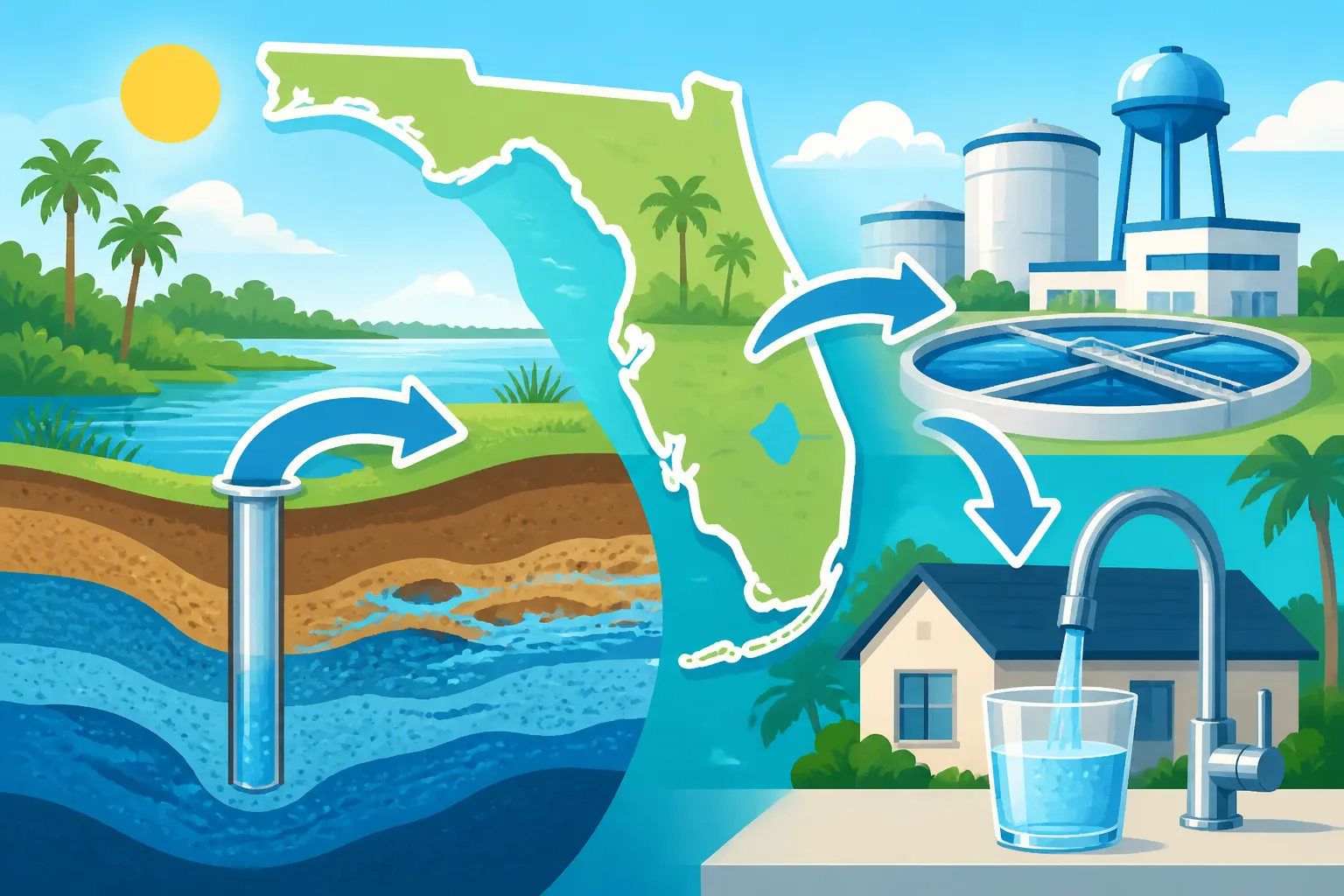
Aquifers are Florida’s primary source of drinking water. The Florida Department of Health describes aquifers as the primary source of drinking water in Florida, and the Florida Department of Environmental Protection says Florida’s ground water provides 90% of the state’s drinking water.
An aquifer is an underground layer of rock, sand or other permeable material that holds and transmits groundwater. Water can enter these layers as rainfall seeps through soil and porous material, or through other connections between the ground and the aquifer. A well gives a utility access to that stored water, which can then be treated and sent through pipes to customers.
The word “aquifer” can make the supply sound uniform, but it isn’t. Groundwater can differ from place to place because the materials it passes through differ. A utility may draw from one source, combine water from multiple sources or change the mix it uses as operating conditions shift. Even nearby communities can have different providers and source-water arrangements.
Florida also has surface-water supplies, such as rivers or reservoirs, and utilities may use a combination of sources. The statewide figure describes the large role groundwater plays overall; it does not tell you precisely where your own utility gets its water. For that, you need the utility’s report or a direct answer from the provider.
Fresh water also serves many purposes beyond household taps. The Florida Department of Environmental Protection lists public water supply, agricultural irrigation, commercial/industrial/institutional uses, domestic and small public supply, recreational irrigation, and power generation among Florida’s uses. Water used for one purpose is not necessarily part of the drinking-water supply. A canal, irrigation well or reclaimed-water line near a home does not by itself indicate where the home’s tap water comes from.
The practical takeaway is that “Florida water” is not one uniform product. The source depends on the local system, and what happens between the source and your faucet depends on the utility’s treatment and distribution network. To identify the provider for your address, start with How to Confirm Which Water Provider Serves a Florida Address. If a larger supplier sells water to a local utility, Wholesaler or Local Utility: Whose Florida Water Report Is Yours? can help clarify whose report to check.
What an aquifer does, and what it does not tell you
An aquifer is a source, not a finished drinking-water system. It stores and moves groundwater, but water drawn from it still has to pass through the steps required by the system that serves it. The aquifer name alone does not tell you whether water has been treated, which tests were performed, or what results were measured in the finished supply.
Groundwater gets its character from its path underground. Water interacts with soil, rock and minerals as it moves and remains below the surface. That can affect properties such as mineral content and hardness. Natural conditions are only part of the picture: land use, nearby activities, wells and surface features can also matter when a utility assesses a source area.
An aquifer can be productive without being identical everywhere. Its water quality and the conditions around it can vary across a broad region, and a utility’s wells may draw from specific locations within that region. One household cannot infer its exact source or water quality simply from knowing that it is in Florida, or even from knowing the name of a nearby aquifer.
It helps to separate three questions:
- Where is the water taken from? This is the source question: a groundwater well, surface-water intake or a combination.
- What happens to it before delivery? This is the treatment question. Treatment varies with the source water and the utility’s system.
- What reaches a particular tap? This also depends on the distribution network and plumbing in or near the building.
The first two questions are mainly about the water system. The last includes the service line and household plumbing, which the utility’s report may not fully describe. A system-wide report is useful, but it is not a direct test of the water from every individual faucet. See Does a Florida Water Quality Report Describe the Water at Your Tap? for more on that distinction.
A private well changes the arrangement. Instead of receiving water through a public utility’s treatment and distribution network, the property owner relies on a well system and is responsible for understanding what is in the water and whether any treatment is appropriate. A nearby public utility report does not stand in for a test of a private well. The separate testing and upkeep questions are covered in Private Well Testing in Florida: Which Tests, and How Often.
Groundwater, surface water and alternative supplies
Groundwater is the dominant source statewide, but it is not the only way Florida communities can meet water needs. The source mix varies by location and system. Some utilities rely heavily on groundwater; others may use surface water, combine sources or pursue alternatives where conventional supplies are limited or under pressure.
The Florida Department of Environmental Protection lists reclaimed water, brackish ground water, and desalination of seawater among alternative water supply sources. These options are not interchangeable, and the term “alternative supply” does not automatically mean that the water is piped directly to a household tap.
| Source or supply type | What it means in broad terms | What to check for your address |
|---|---|---|
| Fresh groundwater | Water drawn from an underground aquifer, commonly through wells | Which wells or groundwater sources the utility identifies |
| Surface water | Water collected from a surface source such as a river or reservoir | Whether the utility uses a surface source, alone or in a blend |
| Reclaimed water | Water treated for reuse; its role depends on the system and intended use | Whether it is used for a non-drinking purpose or as part of a broader supply strategy |
| Brackish groundwater | Groundwater with more dissolved salts than fresh groundwater | Whether it is treated and incorporated into a drinking-water supply |
| Seawater desalination | Seawater treated to remove salts for a supply use | Whether the utility lists desalinated water as part of its source mix |
Reclaimed water deserves particular care in conversation. It is water that has been used and treated for reuse, and its use can reduce pressure on fresh supplies. It may serve purposes such as irrigation or other non-drinking uses. Its presence in a community does not mean it flows to household drinking-water taps. Check the utility’s description of the supply and intended use rather than assuming that all water infrastructure serves the same purpose.
Brackish groundwater is not the same as fresh groundwater. Because it contains more dissolved salts, a system using it for drinking-water supply needs treatment suited to that source. Seawater desalination is another distinct process: it starts with seawater and removes salts to produce water for a supply use. Whether either source contributes to your utility’s drinking water is a local question, not something the statewide list can answer.
Alternative supplies can also be part of a broader water-management strategy without becoming the only source. A utility may use them alongside existing supplies, or use them for a particular purpose that helps conserve freshwater. The report and provider information should make clear whether a source is part of the drinking-water supply, a separate reclaimed-water service, or a planned or supplemental supply.
If you hear that a nearby city uses desalination or brackish groundwater, do not assume that the same source serves your home. Service areas and utility arrangements do not necessarily match city limits. For a closer look at local source mixes, see Desalination and Other Alternative Water Supplies in Florida, Compared and Tampa Bay’s Blend of Groundwater, River Water and Desalinated Seawater. Those are examples of local supply arrangements, not a description of every Florida utility.
How water moves from a source to a customer
The journey from aquifer to tap has several parts. The exact equipment and sequence vary by utility, but the general path is source, withdrawal, treatment, storage or pressure management, distribution and delivery to the property.
Source and withdrawal
For groundwater, a utility draws water through wells. The location and depth of those wells depend on the local source and system design. For a surface-water supply, water is collected at an intake. A utility can rely on one source or use more than one, and the source mix can differ among neighboring systems.
The first useful question to ask is not simply “Which aquifer is under my area?” It is “Which sources does the provider serving my address actually use?” A regional aquifer may extend beyond a single utility’s territory, while a utility may operate a specific set of wells or buy some of its water from another provider.
Treatment
Water is treated before delivery according to the source and the needs of the system. Treatment may involve steps to remove particles, adjust water characteristics or disinfect the supply, but no single treatment recipe applies to every Florida utility. The utility’s report or customer information is the right place to confirm which processes it uses.
It is also important not to treat the source as a prediction of taste or odor. Groundwater from different locations can have different mineral characteristics, and treatment can affect the water’s taste as well. A chlorine-like smell, earthy flavor or other change can have several possible explanations. The source alone is not enough to diagnose it. For practical possibilities, see What Shapes the Taste and Smell of Florida Tap Water?.
Storage, pressure and distribution
After treatment, water enters the utility’s distribution system. Pipes carry it toward homes and businesses, while storage and pressure-management equipment help maintain reliable service. The path may include facilities and pipe networks that are not obvious to customers.
The water delivered to a building can be affected by more than the treatment plant. The condition and material of service lines and household plumbing matter, too. A utility’s source and system-wide results do not establish the condition of every pipe between the plant and a faucet. If you are concerned about lead or older plumbing, Lead Service Lines in Florida: Inventories, Letters and Replacement and Old Plumbing and a Clean Report: What Florida Utilities Can’t Control explain why the utility’s report is only one part of the picture.
The property connection
A water utility generally delivers water to a service connection; the building’s internal plumbing is a separate part of the route. In a rental, apartment building or condominium, the property may also have shared plumbing, a water tank or other equipment between the utility connection and individual taps. These details can affect what to investigate when the concern is limited to one unit or one faucet.
If a taste or odor change occurs throughout the neighborhood, a supply or distribution issue may be worth asking the utility about. If it appears at only one fixture, the cause may be closer to that faucet or building. That is not a definitive diagnosis, but it is a useful first distinction. One Smelly Faucet in a Florida Home: Drain, Aerator or Water Supply? offers a step-by-step way to narrow down where a change may be occurring.
Why neighboring homes may have different water
Two nearby homes can receive water from different utilities, even when they share a mailing city or county. Utility service areas are not always aligned with municipal boundaries. A property can be inside a city’s limits but served by another provider, or outside those limits and still connected to a city system.
A large regional supplier may also sell treated water to a local utility, which then distributes it through its own network. In that arrangement, the wholesaler and the customer-facing provider have different roles. The source and treatment information may be associated with the supplier, while the local utility handles billing, distribution or customer notices. The right report depends on how the supply relationship is organized.
Water can also differ because systems draw from different sources or use different blends. One utility may rely on groundwater while another uses a surface source or a combination. Even when the source is broadly similar, treatment choices, distribution conditions and building plumbing can affect what customers notice.
This is why a neighbor’s report or a citywide claim may not answer a household’s question. Start by confirming the provider for the exact service address. Then ask whether the utility buys water from a wholesaler, which sources are in its supply mix and which report applies to customers. If the address has a private well, the public utility’s report is not a substitute for testing that well.
The same caution applies to online maps and general descriptions of aquifers. A map can provide regional context, but it cannot confirm which utility supplies a particular property. A city boundary, a nearby well field or a reclaimed-water pipe does not necessarily identify the source at the kitchen tap.
How to find your own source and read the utility information
You do not need to understand every part of water infrastructure to get a useful answer. A few targeted checks can identify the provider and point you toward the right source and quality information.
- Confirm the water provider for the service address. Check a recent water bill, ask the property owner or manager, or use the provider’s official website. A property’s mailing address may not be enough to identify its utility.
- Ask whether the provider treats its own water or buys it from another system. If it buys water, ask which provider supplies it and which report covers the water delivered to customers.
- Find the utility’s annual water quality report. Look for the source-water description, treatment overview and monitoring results. Reports may describe source categories or a supply mix rather than identifying the exact well that served your home on a particular day.
- Check whether the report is for the right system and period. A nearby city’s report may belong to a different provider. A newer posting may describe test results from an earlier monitoring period, so check the report’s stated coverage.
- Ask a specific follow-up question. Useful questions include: “Does my service address receive groundwater, surface water or a blend?” “Does another utility supply the water?” and “Where can I find the source-water and treatment description?”
- If the property uses a private well, arrange a well-specific test. A public utility report describes the utility’s system, not a private well on the property.
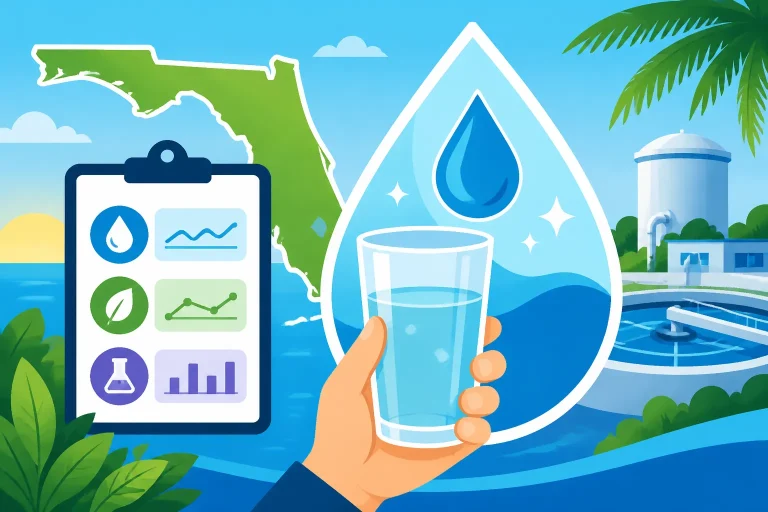
The annual report is often called a Consumer Confidence Report, or CCR. It gives customers information about the system’s water quality and monitoring, but it should not be read as an exact sample from every home. The source description can be broad, and the monitoring information represents the system under its reporting approach. Finding and Reading Your Florida Consumer Confidence Report explains how to locate and interpret the report, while How to Read a Florida CCR: Detected Contaminants and Violations focuses on the results.
If you cannot find the report online, ask the utility where it posts or distributes it. Some providers may offer a copy through customer service or another official channel. Make sure the report belongs to the provider that serves your address. If you are unsure which report applies, City Limits Don’t Decide Which Florida Utility’s Water Report Is Yours can help sort out the service-area question.
A report is useful for understanding the utility supply, but not every household concern is answered by it. For example, a water-quality report is not a plumbing inspection, and the source description is not a measurement of water at a specific kitchen faucet. If results, pipe records or a local notice raise a particular concern, follow up with the utility or the appropriate local professional rather than trying to infer an answer from the aquifer name alone.
What the source can tell you about taste, quality and treatment
Knowing the source gives context, but it is not a shortcut for deciding whether water is safe, choosing a filter or diagnosing a change. A groundwater source may have different mineral characteristics from a surface-water source, but treatment and distribution also shape the finished water. Two utilities using groundwater can still produce water with different taste or odor.
A change in taste or smell does not, by itself, identify the cause. It could relate to the source, treatment, distribution or plumbing. The timing and scope of the change can help frame a useful question: Is it at one tap or throughout the home? Are neighbors noticing it? Did it begin after a maintenance or treatment change? These observations can help you describe the issue to the utility, but they do not replace a test when testing is appropriate.
Likewise, a water quality report should not be treated as a guarantee about every building’s internal plumbing. Utility monitoring and household plumbing answer different questions. If your concern involves a particular contaminant or a filter, first identify the relevant test result or utility information, then check that any treatment equipment is certified for the reduction claim you need and suitable for the water being treated. A filter should not be selected just because a home uses groundwater or because the water tastes a certain way.
The distinction between utility water and well water matters here. A public supply is managed by the provider through its system. A private well is an individual supply that needs property-specific testing and maintenance. A neighbor’s utility report may provide regional context, but it cannot establish what is in a private well.
For utility questions, an annual report is a strong starting point, not the only source of current information. If water changes suddenly or the utility issues a notice, use the utility’s official updates and ask whether the notice applies to your service address. For more on reports and current monitoring, see How to Check Current Water Quality Data for Your Florida Utility. If the issue is a taste or odor change, A Sudden Change in Tap Water Flavor: Checks Residents Can Run can help organize the next checks.
Frequently Asked Questions
Does all Florida tap water come from aquifers?
No. Aquifers are Florida’s primary source of drinking water, and the Florida Department of Environmental Protection says Florida’s ground water provides 90% of the state’s drinking water. Utilities may also use surface water or alternative supplies, depending on the system.
Can I tell my utility’s source from my city or county?
Not reliably. Utility service areas do not always match city or county boundaries. Confirm the provider for your exact service address, then check that provider’s report or ask whether it buys water from another system.
Does a reclaimed-water line mean reclaimed water comes out of my tap?
Not necessarily. Reclaimed water can serve a separate reuse purpose and is not automatically part of the drinking-water supply. Ask the utility what the line serves and whether the drinking-water system uses any alternative supply.
Does knowing my aquifer tell me whether I need a filter?
No. An aquifer name does not identify the water at a particular tap or establish a treatment need. Use the utility’s information or a relevant test result, then check that any treatment product is certified for the reduction claim and matches the result.
Sources
- Florida Department of Health — Private Well Water Testing – Florida Department of Health (checked November 13, 2026)
- Florida Department of Environmental Protection — Onsite Sewage Program | Florida Department of Environmental Protection (checked November 13, 2026)
- Florida Department of Environmental Protection — Water Supply | Florida Department of Environmental Protection (checked November 13, 2026)
Disclaimer
This article is for general informational purposes only and does not constitute professional advice. Laws, prices and regulations vary by location and change over time. Consult a qualified professional for guidance on your specific situation. Florida Water Hub is not a government agency or water utility and is not affiliated with any public water system.