Living Through a Florida Boil-Water Notice: A Household Guide
A boil-water notice can leave a household unsure which taps are affected, whether a filter is enough, and what to do with ice, dishes, pets, or a refrigerator dispenser. The safest first move is to confirm the notice for your address and follow its instructions. This guide helps you plan household water use during the notice and handle cleanup after it ends.
Confirm whether the notice applies to your home
Start with your water utility, not a social media post or a neighbor’s recollection. Contact the utility and give your full address. Ask whether it falls within the notice’s affected area and whether the notice is still active. Notices may cover a limited area, so nearby homes are not always under the same instructions.
Florida DEP says utilities notify individual residences and establishments within an affected area via door-hangers. Check any door-hanger or other notice you received, and keep it handy while you contact the utility. If the notice was sent to a landlord, property manager, or building association, ask them to share the full instructions with everyone who uses the water.
The Florida Department of Health’s boil-water notice list reflects the best information available at the time of publication. The department compiles notice information from press reports, utility data, and information from local authorities. That makes the list useful for checking whether a notice has been reported, but it may not reflect a change that happened after publication. The Florida Department of Health advises that Your utility or county emergency contact will have the latest and most up-to-date information.
If you use the state list, treat it as a starting point and verify the details directly. The list may not resolve questions about your exact street, building, or service address. How to Use the Florida Department of Health Boil-Water Notice List can help you interpret what appears there. If you are unsure whether the notice reaches your block, Does a Florida Boil-Water Notice Cover Your Street? How to Tell focuses on checking the affected area.
| What you need to know | Best place to confirm it |
|---|---|
| Whether your address is included | Your water utility, using your full address |
| Whether the notice is still active | Your utility or county emergency contact |
| What the notice says to do | The notice itself and the utility’s current instructions |
| Whether a door-hanger applies to your home | The notice delivered to your residence, checked against the utility’s affected area |
| Whether a statewide notice list is current | The utility or county emergency contact, since the list is a publication-time snapshot |
Keep a record of the utility’s instructions, including when you checked and what the representative said. That is especially useful in a rental, apartment building, or neighborhood where messages may arrive through several channels. If the utility has an alert system, sign up for messages and check that your contact details are current. Signing Up for Water Advisory Alerts From Your City or Utility covers ways to receive notices directly.
Understand the instruction before using the tap
A boil-water notice is a precautionary instruction for customers in the affected area. The notice should explain what action to take, where it applies, and how customers will be told when it ends. Read the whole notice rather than relying on a short headline or a neighbor’s summary. A message may also include an explanation of the event and instructions that differ by location or water use.
The Florida Department of Health provides guidelines for water systems and regulatory agencies on when to issue a boil water notice. It also provides guidance for restaurants operating under a boil water notice and lists systems under a boil water notice during a natural disaster. Those resources help explain the state’s notice framework, but the instructions for your household still need to come from the notice that applies to your service area.
Pay attention to the type of instruction. A boil-water notice does not mean every water-related situation is handled by boiling. If the notice says not to use the water, or gives a different instruction for a particular use, follow that direction rather than assuming boiling is enough. Boiling is not a universal way to address every possible water-quality concern.
If the wording is unclear, ask the utility what to do for the specific task you have in mind. For example, ask separately about drinking, preparing food, making ice, washing produce, bathing, and using appliances. Do not guess based on a notice issued elsewhere. How Florida Utilities Decide on a Precautionary Boil-Water Notice explains why utilities may issue a notice and why the instructions are tied to the conditions they are addressing.
Make a household plan for drinking and food
Until the utility or county emergency contact confirms the notice has ended, follow the directions in the notice for water used in food and drink. Where the notice directs customers to boil water or use bottled water, use one of those options as instructed. Do not treat water as safe for a use simply because it looks clear, has no unusual odor, or tastes normal.
A practical household plan keeps the drinking-water option separate from tap water. Set aside bottled water or water that has been prepared according to the notice, and label or store it so household members can identify it. If several people share a kitchen, tell everyone which water is for drinking and food preparation. This avoids a common mix-up: a person sees water in a pitcher or bottle and assumes it has been prepared for use.
Check the notice for its exact directions on boiling. Do not substitute a remembered instruction from a different event or location. If you cannot find the instructions, contact the utility or county emergency contact and ask what to do before preparing water for drinking or food.
Think through the less obvious ways water gets into food and drinks. Use the approved water option for:
- Drinking, including water poured into a glass or bottle.
- Preparing drinks, such as coffee, tea, or powdered beverages, if the notice requires boiled or bottled water for those uses.
- Cooking, including water added to a pot, kettle, soup, or other recipe.
- Washing fruits and vegetables when the notice’s instructions call for an approved water source.
- Brushing teeth if the notice directs customers to use boiled or bottled water for that purpose.
- Making ice, unless you are using ice made from an approved water source.
Empty ice trays and do not use ice made during the notice unless the utility’s instructions say it is acceptable. Ice can be easy to overlook because it may be in a dispenser, a freezer bin, a portable ice maker, or a cooler. If you are unsure when the ice was made or what water it used, do not use it for drinks or food until you have confirmed the appropriate cleanup steps.
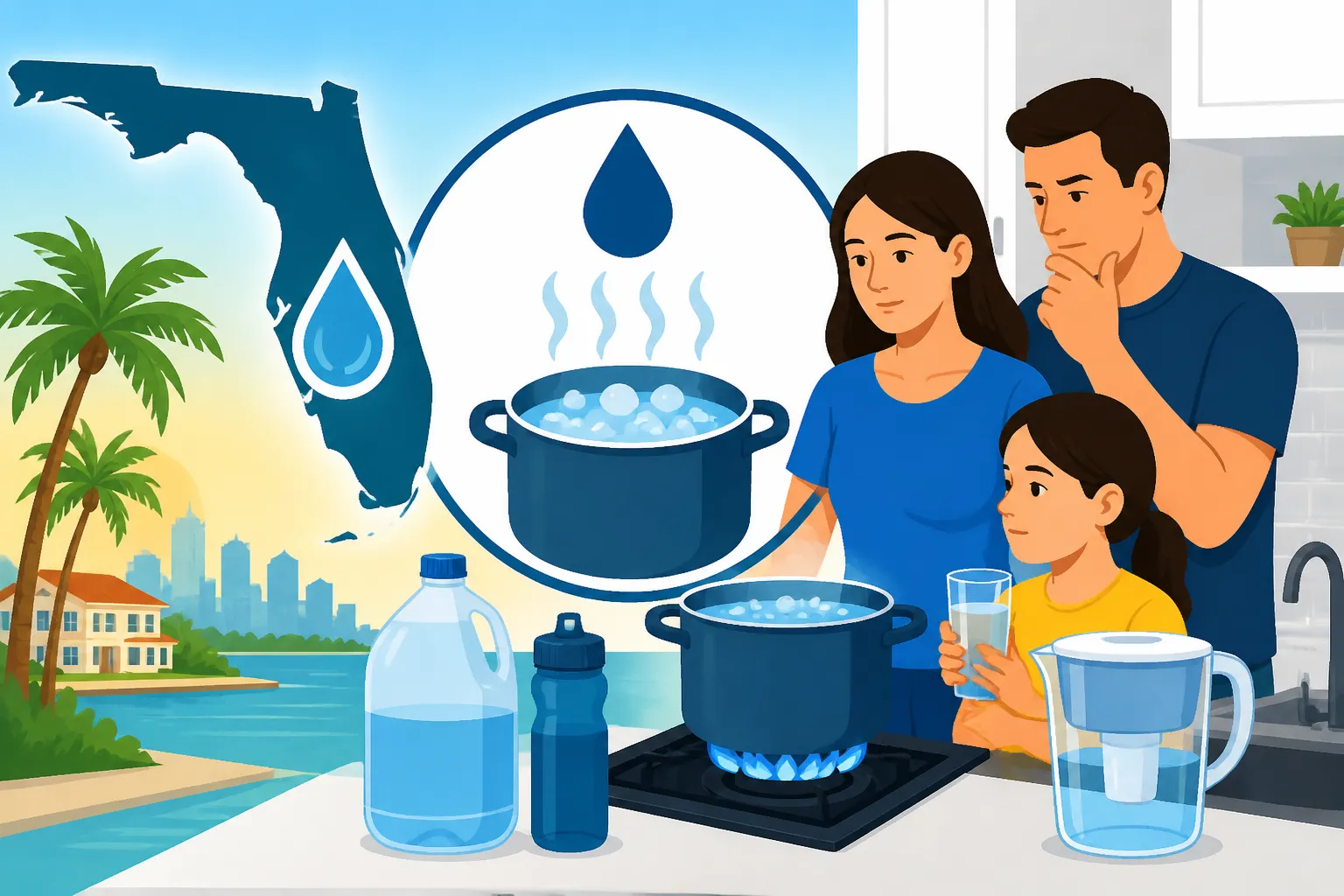
A refrigerator dispenser or countertop pitcher does not make untreated tap water a substitute for boiling or bottled water. During a notice, the Florida Department of Health advises customers not to use home filtering devices in place of boiling. A filter designed to improve taste or reduce particular substances should not be assumed to address the concern behind a notice. Will a Refrigerator Filter Do Instead of Boiling in a Florida Notice? looks more closely at this question.
If bottled water is hard to find or difficult to carry, ask your utility or local emergency contact what options are available in your area. Avoid relying on rumors about a distribution site or an unofficial post. Confirm current details through the official utility or county contact.
Handle dishes, hygiene, pets, and household routines carefully
A notice affects more than the glass you drink from. Consider each routine that uses tap water, then follow the notice’s directions for that use. If the notice is silent on a particular task, do not assume the silence means that use is automatically allowed; ask the utility or county contact for clarification.
Dishes and food-contact surfaces
Use the notice’s instructions for washing dishes, utensils, cutting boards, and food containers. If it specifies an approved water source for washing, follow that direction. Be careful with items that hold water or touch food directly, such as reusable bottles, baby bottles, blender parts, and the inside of a coffee maker. If you are uncertain whether an item can be cleaned safely during the notice, use an approved alternative or wait for instructions.
Do not assume that a dishwasher or appliance filter makes the water suitable. Appliance designs differ, and the notice may not address every model. Ask the utility about the water use and consult the appliance manufacturer for operating guidance if needed.
Handwashing and bathing
Follow the notice’s advice for handwashing and bathing. If the notice gives a specific restriction or precaution, use that wording rather than applying a general rule from another event. Take extra care to prevent water from being swallowed while bathing, especially for young children. If someone has an unusual health concern or needs individualized advice, contact a medical professional or local health department.
Pets and aquarium water
Include pets in the household plan. Ask your utility whether the notice’s drinking-water directions apply to animals, and use an approved water source if directed. Do not assume that a pet’s water bowl is a separate exception.
Aquariums, ponds, and other water-dependent systems need different care from a drinking glass. Do not make a sudden change to an aquarium based on a general notice summary. Ask the utility what the notice requires for that use and seek advice from an appropriate aquarium professional if you need help maintaining the system.
Laundry and cleaning
Check the notice for directions on laundry, cleaning, and other household uses. Where the notice does not provide a clear answer, contact the utility rather than inferring that water is acceptable for every non-drinking task. A household can reduce mistakes by posting the notice’s instructions near taps or sharing them with anyone who may use the water, including visitors and caregivers.
For more specific household questions about teeth, ice, showers, and pets, see Teeth, Ice, Showers and Pets During a Florida Boil-Water Notice. That resource complements the notice itself; it does not replace local instructions.
Manage filters, appliances, and plumbing during the notice
During the notice, do not rely on a home filter instead of boiled or bottled water when the notice calls for those options. The Florida Department of Health in Hillsborough County states, Do not use home filtering devices in place of boiling. This caution matters for pitcher filters, faucet-mounted units, under-sink systems, refrigerator dispensers, and whole-house equipment: a filter’s presence does not tell you whether it addresses the concern behind the notice.
If you have a filter or treatment system, keep its model information and manufacturer instructions available. Ask the utility whether the notice gives any equipment-specific direction. If it does not, avoid guessing about bypassing, shutting down, or continuing to operate a system. Equipment varies, and the correct step can depend on its design and the notice instructions.
Do not make a permanent change to plumbing or treatment equipment simply because a notice is active. A temporary event does not establish what treatment a home needs afterward. If you are already considering treatment for a separate water concern, use the utility’s report or an appropriate water test to identify the issue before choosing equipment. Utility Report or Home Test? Choosing a Filter or a Florida Property explains how to decide whether information about utility water is enough or whether a household test may be useful.
For refrigerators, ice makers, coffee makers, and other appliances connected to the water line, find the manufacturer’s instructions and check whether the utility has provided guidance. Avoid making ice during the notice unless the approved water source and appliance directions allow it. Keep track of any ice or water already stored in the appliance so it is not mistaken for water made after the notice.
If the notice occurs during a storm or other emergency, expect information to arrive through different channels and at different times. Confirm whether a message applies to your address, especially if you live near a boundary between service areas. The Florida Department of Health list may report systems affected during a natural disaster, but the utility remains the best contact for the latest information about a particular address.
Wait for the all-clear, then follow cleanup instructions
Do not end precautions just because water pressure has returned, the water looks normal, or a neighbor says the notice is over. Wait for confirmation from the utility or county emergency contact. If the utility provides a formal all-clear or a notice-lifting message, keep it until you have completed the cleanup instructions.
The Florida Department of Health’s list is useful for checking reported notices, but it represents the best information available at the time of publication. For the latest status, the department directs customers to their utility or county emergency contact. Who Gives the All-Clear When a Florida Boil-Water Notice Ends? explains why customers should rely on the official notice-lifting information rather than guess from conditions at home.
After a notice is lifted, follow the utility’s cleanup instructions. Florida Department of Health in Hillsborough County guidance says to flush household pipes and change refrigerator filters after the notice is lifted. It does not give a specific instruction for whole-house filters, so follow the filter manufacturer’s directions. If your utility gives different or more detailed instructions, follow the current local direction.
A careful return-to-use routine can include:
- Checking the utility’s all-clear message and any instructions that came with it.
- Flushing household pipes as directed by the local guidance.
- Changing a refrigerator filter as directed by the manufacturer and the applicable local instructions.
- Discarding ice that may have been made during the notice, if instructed.
- Cleaning or restarting water-connected appliances according to manufacturer directions and utility guidance.
- Returning to normal use only after completing the steps that apply to your home.
Do not assume that a whole-house filter needs the same action as a refrigerator filter. Filter types and configurations differ. If manufacturer directions are unclear, contact the manufacturer or a qualified service professional, and check with the utility if you are unsure whether local instructions apply to that equipment.
If your home has a private well rather than utility water, do not assume a public-system notice applies to your well, or that the absence of a notice means the well is safe. Contact the local health department for advice relevant to a private well and the event affecting your area.
Reduce confusion while the notice is active
A household plan works best when everyone hears the same instructions. Share the notice with other residents, caregivers, guests, and anyone who may prepare food or drinks. If the home is rented or part of a multi-unit building, ask the property manager how official updates will be passed along and whether the building has additional instructions.
Keep a small written note by the kitchen sink or refrigerator with the current direction, the affected address, and where to get updates. Use a simple distinction such as approved drinking water versus tap water, but make sure the note does not conflict with the official instructions. Remove it when the notice is lifted and cleanup is complete, so an outdated warning does not create confusion later.
When contacting the utility, make your question specific. Instead of asking whether the water is safe in general, provide your address and ask whether it is in the notice area, whether the notice is still active, and what to do for the exact use you are concerned about. If you receive conflicting information, ask which message is the latest and how the utility will announce the all-clear.
If you cannot reach the utility, try the county emergency contact listed for current notices. Do not use an old number or unofficial contact details; find current information through the official utility or agency website. Keep checking the official channel until you have a clear answer.
A notice can be inconvenient, particularly when it arrives unexpectedly. Avoid trying to solve uncertainty with an improvised treatment method or an online claim about a different neighborhood. The reliable sequence is to verify the affected area, follow the current instructions, use an approved water source for the uses covered by the notice, and complete local cleanup guidance after the all-clear. For information about how notices are announced, see How Florida Cities and Counties Announce Boil-Water Notices. For the steps after an advisory ends, see What to Flush and Replace After a Florida Boil-Water Notice Lifts.
Frequently Asked Questions
Does a Florida boil-water notice automatically apply to every home nearby?
No. A notice can apply to a defined affected area. Contact your water utility with your full address and ask whether the notice covers it. Check any door-hanger or other notice delivered to your residence as well.
Is a refrigerator filter a substitute for boiling water?
No. The Florida Department of Health advises customers not to rely on home filtering devices in place of boiling during a boil-water notice. Follow the notice’s directions for boiled or bottled water.
Can I stop boiling when the water looks clear?
No. Appearance is not confirmation that the notice has ended. Wait for an all-clear from your utility or county emergency contact and follow the cleanup instructions that apply to your home.
What should I do with a whole-house filter after the notice ends?
Follow the manufacturer’s directions. Florida Department of Health in Hillsborough County guidance advises flushing household pipes and changing refrigerator filters after the notice is lifted, but does not give a specific instruction for whole-house filters.
Sources
- Florida Department of Health — Boil Water Notices – Florida Department of Health (checked November 13, 2026)
- Florida Department of Health — Drinking Water – Florida Department of Health (checked November 13, 2026)
- Florida Department of Health in Hillsborough County — Boil Water Notice (BWN) (checked November 13, 2026)
Disclaimer
This article is for general informational purposes only and does not constitute professional advice. Laws, prices and regulations vary by location and change over time. Consult a qualified professional for guidance on your specific situation. Florida Water Hub is not a government agency or water utility and is not affiliated with any public water system.