Is Florida Tap Water Safe to Drink? How to Check Your Own Utility
Florida tap water comes from different sources and is managed by different utilities, so a statewide answer cannot tell you exactly what is coming from your own faucet. To check your water, identify the provider for your address, find its current water quality report, and look for results or advisories that affect your service area. Here’s how to do that—and what the findings can and can’t tell you.
What “safe to drink” means for Florida tap water
For most Floridians, drinking water comes from a public water system. According to the Florida Department of Health, About 88% of Florida residents receive water from public water systems. That does not mean every home receives water with the same source, treatment process, or taste. A utility’s results are specific to its system and the samples it collects.
According to the Florida Department of Health, owners of public water systems are required to conduct routine water quality testing and to properly maintain and operate the system according to Florida rules. The Florida Department of Environmental Protection has the primary role of regulating public water systems in Florida. Its Division of Water Resource Management implements state laws protecting the quality of Florida’s drinking water.
That system of testing and oversight is an important starting point, but “safe” should not be treated as a blanket promise about every faucet, every building, or every moment. A utility report describes water tested within the system; it may not reveal a problem introduced by plumbing inside a home or building. And an annual report is not the same thing as an immediate update during a water emergency.
A useful way to approach the question is to separate it into three parts:
- What does the utility’s report say about the water it supplies? Check the provider’s report for the period covered, reported results, and any listed violations or notices.
- Is there a current advisory for your location? A temporary notice can change what you should do, even if the annual report shows that the system met applicable requirements during the reporting period.
- Could the issue be inside your property? Older plumbing, a service line, a water heater, or a faucet can affect what comes out at a particular tap.
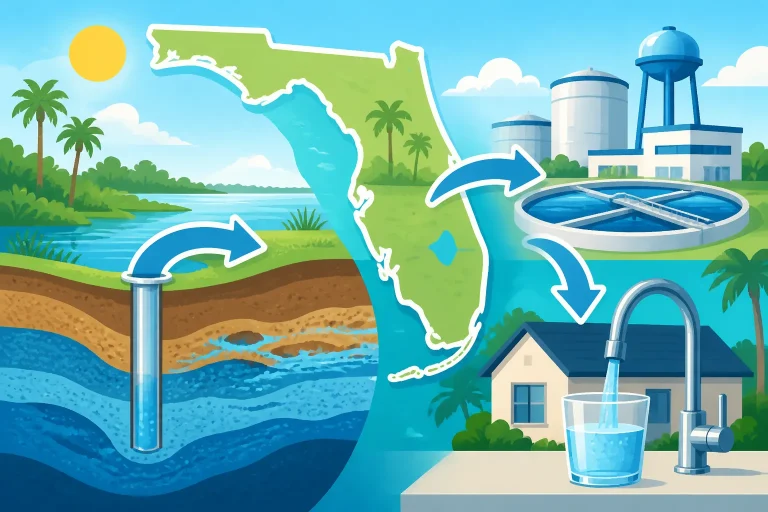
For context on where public water comes from before it reaches the treatment plant, see Where Florida Drinking Water Comes From, Aquifer to Utility. If you are trying to understand whether a report applies to your exact address, City Limits Don’t Decide Which Florida Utility’s Water Report Is Yours explains why city boundaries alone may not identify your provider.
The practical takeaway is to check the utility serving your address rather than rely on a statewide impression, a neighbor’s report, or a general claim that Florida water is safe or unsafe. If you are on a private well, the process is different: a public utility report does not describe your well water. Start with Private Well Testing in Florida: Which Tests, and How Often instead.
Find the water provider for your address
Before reading test results, confirm which utility supplies your property. People can live in a city, county, or neighborhood without receiving water from the provider they expect. A home may be served by a city utility, a county or regional provider, or another public system. The utility listed on a bill is a good clue, but it may not be the water supplier if an owner, landlord, association, or property manager handles the account.
Try these checks:
- Look at a recent water bill and note the name of the provider. If you rent, ask the landlord or property manager who supplies the water and whether the bill is separately metered.
- Search the official utility or local government website using your street address or neighborhood. Look for service-area maps, customer account tools, or a page describing the provider’s coverage.
- If the property is in an apartment, condominium, manufactured-home community, or other multi-unit site, ask whether the building receives utility water directly or is served through a shared arrangement.
- If the bill name and online information do not match, ask the provider which water system serves the property. Use contact details from the official utility website.
- If the property uses a private well, a public utility’s report is not the right source for your drinking water. Ask the owner or property manager who maintains the well and request recent laboratory results.
The point is to match the address to the system, not simply to find a report from the closest city. A report from a nearby utility can be useful background, but it cannot confirm the results for a different provider. This matters especially near municipal boundaries, where addresses and service areas do not always line up neatly.
Renters can still investigate even if the water account is not in their name. Ask the landlord which utility serves the building, whether the building has any treatment equipment, and whether a current advisory has been issued. For more on locating information without a utility bill in your name, see No Water Bill in Your Name: How Florida Renters Still Get the CCR.
Once you know the provider, save its official water-quality page or report. Use the utility’s own site to confirm that the report is current and to find any alert or notice pages. A search result, a social media post, or a file copied to another website may be outdated or may describe another service area.
Get and read the utility’s water quality report
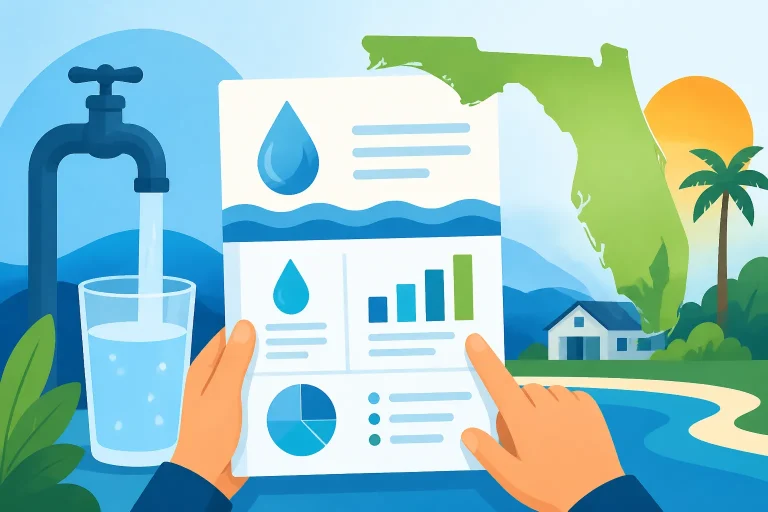
Public water providers commonly publish a Consumer Confidence Report, often shortened to CCR, as a summary of water-quality information. The report is a starting point for checking routine results, not a live reading of the water at every tap. If you cannot locate it online, contact the utility using its official website and ask how to get the report.
When you open a report, begin with its identifying information. Check the water system name, the period covered, and whether the report applies to your address. Then look for the sections that explain the water source, treatment, detected substances, and any violations or special notices. Reports can be technical, so read the explanatory notes as well as the tables.
| What to check | What it helps you understand | What it does not establish by itself |
|---|---|---|
| Water system name and coverage | Whether the report may apply to your property | Whether a neighboring utility’s results apply to you |
| Reporting period and sample dates | When the reported testing took place | Whether conditions have changed since sampling |
| Source water and treatment description | Where the system’s water comes from and how it is treated | Whether every household tap has the same plumbing conditions |
| Results table and units | Which substances were reported and how results are presented | Whether a result can be interpreted without its benchmark and notes |
| Violation or notice section | Whether the report identifies a compliance issue during the period | Whether a current emergency notice is in effect now |
| Contact and explanatory notes | Where to ask follow-up questions and how to read the report | Whether an unresolved household plumbing issue is absent |
Read the table with its notes
A results table may include a substance name, a measured result, a comparison value, and a note about how or when the sample was collected. Read the column labels and footnotes before drawing a conclusion. A result can be confusing when a report uses abbreviations, different units, or a range of sample dates.
Do not treat a detection as proof that the water is unsafe, and do not assume that a result listed as compliant means every home tap has been tested. The meaning depends on the substance, the reported level, the relevant benchmark, the sampling method, and the report’s explanation. If you cannot tell what a line means, ask the utility to explain the result and point you to any relevant notice.
Likewise, a report with no listed violation is not a guarantee about an individual faucet or a current event. Reports summarize testing and system information over a stated period. A utility may issue an urgent notice separately if conditions call for immediate action. See How to Read a Florida CCR: Detected Contaminants and Violations for help interpreting report tables, and Does a Florida Water Quality Report Describe the Water at Your Tap? for the limits of system-level results.
Check more than the headline
A report may include an introductory summary, but the headline is not a substitute for the data and notes. Look for a specific result that concerns you, then read the explanatory material associated with it. If the report uses a technical term you do not recognize, write it down before calling the utility. A focused question is easier to answer than a general request to explain the whole report.
You can also compare the report’s details with current information on the utility’s website. The annual report and current alert page serve different purposes: one summarizes water-quality information for a reporting period, while the other may communicate a developing issue. If the report seems difficult to find, Florida Water Quality Report Hard to Find Online? How to Get a Copy covers ways to request it.
Check for current notices before relying on an annual report
A water quality report is not a substitute for checking whether the utility has issued a current advisory. A temporary problem, maintenance work, or an event affecting service may prompt a separate notice with instructions for customers. A past report cannot tell you whether a new notice has been issued since it was prepared.
Check the official utility website for notices, service alerts, and updates that mention your street or service area. If the utility provides email or text alerts, consider signing up so you do not have to rely on noticing a post later. You can also check official local or state information when a notice directs customers there. For details on the types of messages utilities use, see How Florida Cities and Counties Announce Boil-Water Notices.
Read any notice carefully and follow its instructions as written. Confirm the affected area, the type of advisory, the uses it applies to, and what the utility says customers should do. Do not assume that a notice covers every customer in a city—or that it excludes you simply because a nearby street is not named. If the map or description is unclear, ask the utility to confirm whether your address is included.
A boil-water notice is one example of a temporary advisory, but it is not the only possible water message. A notice may describe a precaution, a specific contaminant concern, or a different service issue. The instruction depends on the notice. Do not substitute a familiar response, such as boiling water, for a different instruction without checking what the utility or relevant agency has said.
When a notice is lifted, verify that the utility has officially ended it before returning to normal use. Information passed along by a neighbor may be well intentioned but can lag behind an official update. Who Gives the All-Clear When a Florida Boil-Water Notice Ends? explains why it is worth checking the source of the update.
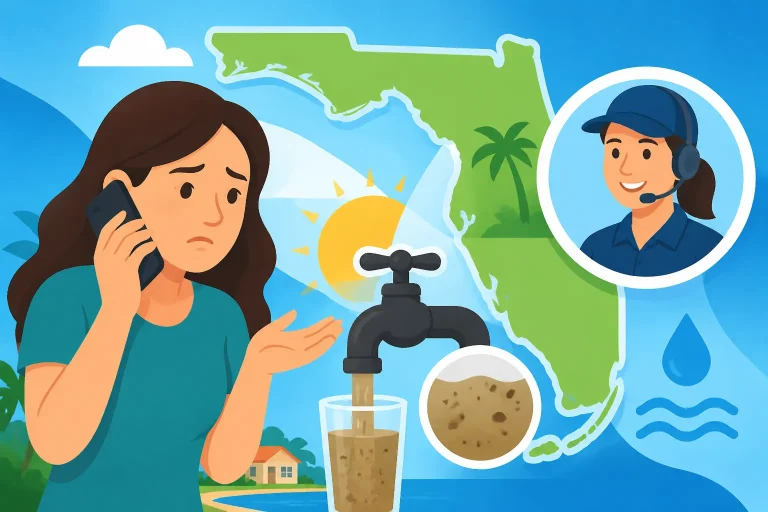
If a notice is not easy to find, contact the utility through its official website and ask whether a current advisory applies to your address. Be prepared to give the street address and describe the message or symptom that prompted your call. If the issue appears to be a health concern, ask the local health department or a medical professional for health guidance rather than trying to interpret possible health effects from a report alone.
Tell a system-wide concern from a home plumbing issue
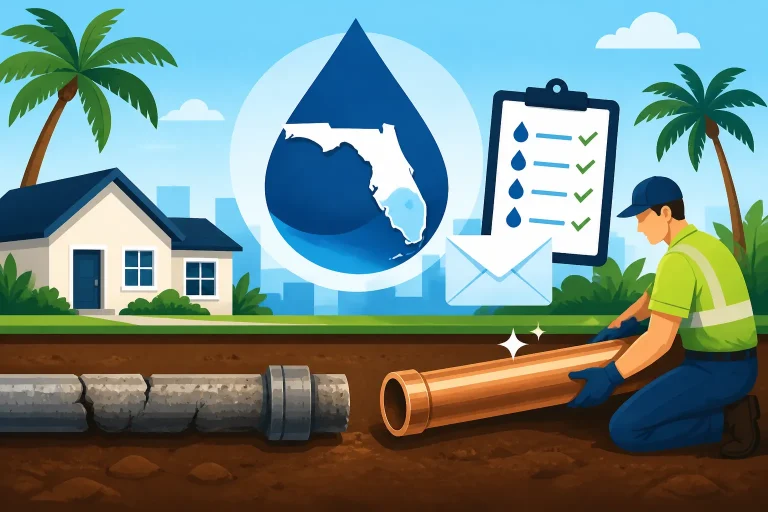
A report can describe water in a public system without describing every pipe between the system and your glass. Water may travel through a service line and through plumbing inside a home or building before reaching a faucet. The condition and materials of those pipes, along with fixtures and equipment, can affect water at a particular tap.
This is one reason a neighbor’s report of normal water does not settle a concern in your own kitchen. If the taste, smell, color, or appearance changes at one faucet but not elsewhere, the source may be local to that fixture or building. If several homes or multiple taps are affected, the issue may call for a wider check—but that pattern alone does not identify the cause.
A practical way to compare is to notice where and when the issue occurs:
- Does it appear at one faucet or at several?
- Does it affect cold water, hot water, or both?
- Does it occur in a single unit, throughout a building, or across a neighborhood?
- Did it begin after plumbing work, a period of disuse, or a change in utility service?
- Is there an official notice that describes the same area or condition?
These observations can help you explain the issue to the utility, landlord, plumber, or laboratory. They are not a diagnosis. Avoid assuming that an unusual smell or color proves a particular contaminant is present—or that the lack of an unusual taste or smell proves the water is free of one. A water-quality test, an official advisory, and a plumbing inspection answer different questions.
If you are concerned about lead, for example, the utility report alone may not describe the plumbing inside your home. Check any service-line information available for your address and ask the utility what it can confirm. For background, see Lead Service Lines in Florida: Inventories, Letters and Replacement and Old Plumbing and a Clean Report: What Florida Utilities Can’t Control.
If the concern is limited to a rental or one tap, let the landlord or property manager know and request an investigation. If it appears to affect the wider service area, report it to the utility. Who to Contact About Tap Water Problems in Florida can help you decide which organization to approach for different kinds of concerns.
Decide whether you need more information or a home test
A utility report may answer a general question about the public system, but it will not answer every property-specific question. A test may be useful if you have a particular concern about water at your tap, your building’s plumbing, or a private well. Before ordering a test or buying treatment equipment, define the question you want answered.
Start with the concern, not a product. Are you trying to understand a reported contaminant, investigate a change in taste, check a possible plumbing issue, or learn whether a private well has a specific water-quality concern? The answer affects the type of sample and test that may be appropriate. A general home test kit may not measure the substance or concentration you care about, and a broad panel may include tests unrelated to your situation.
For public water customers, contact the utility first when the concern could involve the water it supplies. Ask whether the utility has relevant current test information, whether it recommends a particular follow-up, and whether it can explain the result you saw. A utility’s ability to test water inside an individual home can vary, so ask what service is available rather than assuming that sampling is offered.
If you choose an independent test, find out who will collect the sample, which laboratory will analyze it, what the test measures, and how the result will be reported. Follow the laboratory’s sampling instructions carefully. A sample taken from the wrong location or collected in the wrong container may not answer the question you intended to ask. Where a state-certified laboratory is appropriate, confirm that it is certified for the specific test you need; certification for one analysis does not necessarily cover every substance.
A lab result also needs context. Look at the sample location, collection date, units, method, and comparison value. Ask the laboratory what the result can establish and whether follow-up testing is recommended. If the result concerns possible health effects, take it to the local health department or a medical professional for guidance. Do not use a treatment salesperson’s test as the only basis for choosing equipment when an independent laboratory result is needed.
For help deciding between a utility report and a home sample, see Utility Report or Home Test? Choosing a Filter or a Florida Property and Testing Your Own Tap in Florida When the Utility Report Isn’t Enough. If you do order a test, Units, Limits and Flags on a Florida Water Lab Report, Decoded can help you understand how to read the result.
Test before choosing treatment
Treatment should match a measured or clearly identified concern. A filter or other treatment device is designed to reduce certain substances under specified conditions; no product should be assumed to remove every possible contaminant. Check the exact model’s certification and reduction claims against your test result, and follow the manufacturer’s instructions for installation and upkeep.
Do not buy a system simply because your water tastes different from bottled water or because a neighbor has installed a filter. Taste and odor preferences are not the same as a contaminant finding. If treatment seems appropriate, compare the contaminant identified, the device’s verified claim, its maintenance needs, and whether the treatment is intended for a single tap or the whole building. Which Water Tests to Run Before Buying a Filter in Florida and Filter, Softener or Both? Deciding What Your Florida Water Needs offer more context on matching test results to treatment choices.
What to do when information is missing or worrying
If you cannot find a report, do not assume that no report exists or that the water is unsafe. Ask the provider to identify the correct water system and explain how customers can obtain its water quality information. If you do not know which provider serves the property, establish that before interpreting a report from another area.
If a result is unclear, ask the utility specific questions:
- Which water system and service area does this result cover?
- What period and sampling locations does the report describe?
- What does the result mean in relation to the comparison value listed?
- Is there a current notice or follow-up information for customers?
- Does the result describe treated water at the system, or was water sampled at a customer’s tap?
- If the concern is at a home, what kind of sample or other check would help narrow it down?
Keep notes on the report title, the result or notice you are asking about, and the date you checked the utility’s information. If you are a tenant, include the property manager in the conversation when the issue could involve building plumbing or shared equipment. When there is a current advisory, follow the official instructions rather than waiting for a general explanation of the annual report.
For an unresolved concern about the public water system, use the official utility or agency website to find current contact details and ask where the issue should be directed. The Florida Department of Environmental Protection’s role includes regulating public water systems, while the Florida Department of Health provides public health information. Which office is appropriate depends on the question and the circumstances. Who Regulates Your Tap Water? DEP, DOH and the Counties explains how those roles relate.
If you suspect a plumbing problem, a utility may not be able to assess everything inside the building. Ask the property owner or a qualified plumbing professional to investigate the relevant pipes, fixtures, or equipment. If you are worried about an immediate health effect, contact the local health department or a medical professional. An unusual taste or appearance alone cannot establish a health diagnosis.
Frequently Asked Questions
Is Florida tap water safe to drink?
There is no single answer for every address. Public water systems are subject to testing and oversight, but the relevant report and any current notice belong to the system serving your property. Check that provider’s information and consider whether plumbing inside the building could affect your tap.
Does a clean utility report guarantee my home’s water is fine?
No report can establish the condition of every household faucet. A utility report describes system-level water-quality information, while local plumbing, service lines, and fixtures can affect water within a property. A household test or plumbing check may be useful if you have a specific concern.
What should I do if my water suddenly tastes or smells different?
Check the utility’s official notice page, compare whether the change occurs at one tap or across the property, and contact the utility if the cause is not clear or multiple customers may be affected. Do not rely on taste or smell alone to identify a contaminant. For a more focused checklist, see A Sudden Change in Tap Water Flavor: Checks Residents Can Run.
Does the public utility report cover private well water?
No. A public utility report describes the system named in the report, not an individual private well. Well owners should arrange appropriate testing based on their water source and concerns, and should ask the local health department or a qualified laboratory for guidance.
Sources
- Florida Department of Health — Private Well Water Testing – Florida Department of Health (checked November 13, 2026)
- Florida Department of Environmental Protection — Source & Drinking Water Program | Florida Department of Environmental Protection (checked November 13, 2026)
Disclaimer
This article is for general informational purposes only and does not constitute professional advice. Laws, prices and regulations vary by location and change over time. Consult a qualified professional for guidance on your specific situation. Florida Water Hub is not a government agency or water utility and is not affiliated with any public water system.