Who to Contact About Tap Water Problems in Florida
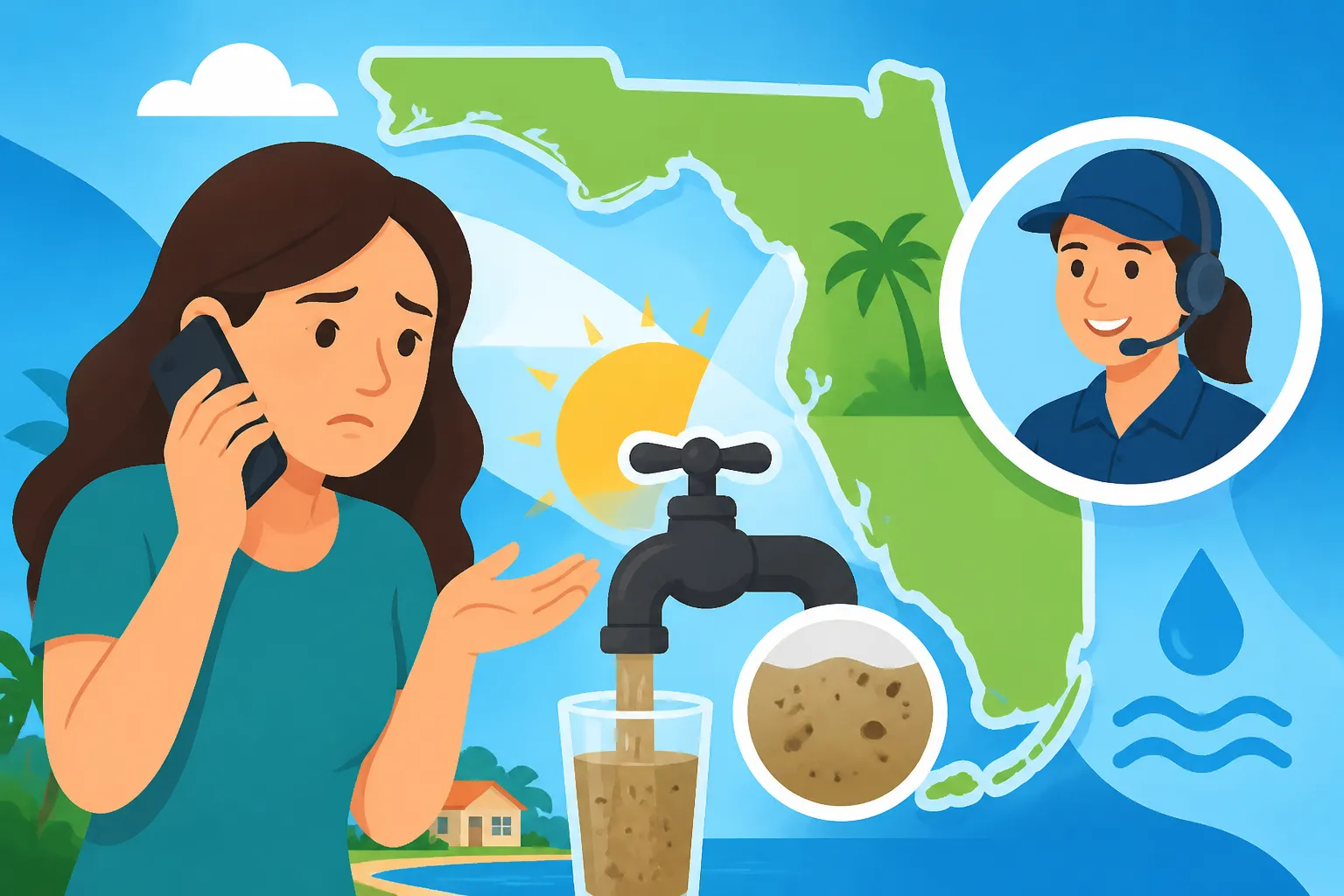
When Florida tap water looks, smells, or tastes different, it can be hard to know whether to call the water utility, a county office, or a state agency. The right contact depends on the problem, who supplies the water, and whether there is an active advisory. Start with the steps below to identify the responsible provider and make a useful report.
Start With the Water Provider
For most concerns about water from a public utility, begin by contacting the utility that serves the property. It can check whether the issue is known, confirm whether an advisory applies, and explain what it is investigating. If you are unsure which provider serves your address, use How to Confirm Which Water Provider Serves a Florida Address before reporting the problem.
A change that affects several homes may point to a supply or distribution issue, while a problem at one tap may involve the fixture or plumbing inside the building. That distinction is useful, but it does not prove the cause. Tell the utility what you noticed and whether neighbors have noticed it too rather than assuming the source.
Use the utility’s official website or customer communications to find current contact details. Look for a water-quality or water-emergency contact if one is listed, and use the utility’s current instructions for urgent reports. A regular billing contact may be able to route a call, but a dedicated water-quality contact may be more direct when the concern is about appearance, taste, odor, pressure, or an advisory.
If the water provider is not obvious, check a recent bill, lease or property documents, or ask the property manager who supplies the water. A landlord or manager may know whether the building uses a public utility, a small shared system, or a private well. If the name on a bill is a city or county, that does not always settle which organization operates the water system; the provider serving the address is what matters.
Contact the utility promptly for these concerns
Reach the utility when you notice a sudden change that may affect more than one tap or home, such as:
- A new or unusual taste, smell, or color across the home
- Cloudiness or particles that do not clear as expected
- A sudden loss of pressure or an interruption in service
- A water main break or visible work near a water line
- A notice from the utility that you do not understand
- A concern that an advisory may apply to your address
- A change that neighbors are also reporting
These signs do not establish that water is unsafe, and a clear appearance does not establish that it is safe. The most useful first step is to tell the provider what happened and ask whether it knows of a system-wide issue or has issued current instructions.
Use the right contact for an urgent advisory
If you have heard about a boil-water notice, do not rely on an old social media post, a neighbor’s recollection, or a search result that may not reflect the latest status. The Florida Department of Health says: Your utility or county emergency contact will have the latest and most up-to-date information.
Confirm whether the notice covers your address, what uses it affects, and whether it remains active. If the utility’s notice and another source appear to differ, ask the utility or county emergency contact to clarify the current instructions. For more help checking an advisory and understanding its scope, see How to Use the Florida Department of Health Boil-Water Notice List and Does a Florida Boil-Water Notice Cover Your Street? How to Tell.
Do not assume that an advisory is over just because water pressure has returned or the water looks normal. Follow the current notice until the responsible utility or county contact confirms the status. Who Gives the All-Clear When a Florida Boil-Water Notice Ends? explains why the source of that confirmation matters.
Match the Contact to the Problem
The fastest route is usually to separate the problem into a few basic questions: Is there an active warning? Is the issue limited to one fixture or happening across the property? Is it affecting nearby homes? Who supplies the water? Those answers help direct the report without trying to diagnose the cause yourself.
| What you notice | First contact | What to ask |
|---|---|---|
| A boil-water notice or uncertainty about whether one is active | Your utility or county emergency contact | Does the current notice include this address, and what instructions apply? |
| A sudden change across several taps or homes | The water utility | Is the utility aware of a system issue, and what should customers do while it investigates? |
| A change at one faucet only | The property manager or an appropriate plumbing professional; contact the utility if the cause is unclear | Could the issue be limited to this fixture or building plumbing, and is there a known utility issue? |
| A pressure loss or interruption | The utility | Is service affected in this area, and has the utility issued any water-use or safety instructions? |
| A concern about a water quality report | The utility that issued or provides the report | Which system and monitoring period does the report describe, and where can current information be found? |
| A very small shared system that supplies water for public consumption | The county health department or Department of Health | Which office oversees this system, and who should receive the concern? |
| A private well concern | Ask the county health department which office or testing route is appropriate | What information or testing is relevant to this property and concern? |
The table is a starting point, not a substitute for an active notice. When a warning is in effect, follow the notice and confirm current details with the utility or county emergency contact. For a taste or odor question that is not urgent, the utility can often say whether a treatment change or other known event is being investigated. If the problem seems limited to one faucet, a fixture check may be reasonable, but contact the utility if the change is unexplained, persists, or appears elsewhere.
Taste, smell, color, or cloudiness
A noticeable change can be unsettling, especially when it appears suddenly. Describe it without trying to name a contaminant. For example, report that the water has an earthy odor, looks yellow, or has visible particles; avoid concluding that a particular substance is present based on appearance alone.
If only one faucet is affected, note that in the report. If both hot and cold taps, several rooms, or neighboring homes are affected, include that as well. These comparisons can help the utility decide whether to check the distribution system or whether the issue may be local to a building or fixture. What Shapes the Taste and Smell of Florida Tap Water? offers context on why water can vary in taste or odor, while One Smelly Faucet in a Florida Home: Drain, Aerator or Water Supply? helps consider a localized issue.
A visual or sensory observation cannot identify all water quality concerns. If you want to understand what a utility report says about measured contaminants, see Finding and Reading Your Florida Consumer Confidence Report and Does a Florida Water Quality Report Describe the Water at Your Tap?. A report may help explain monitoring, but it does not automatically answer what caused a new change at a particular faucet.
Pressure loss, interruption, or visible utility work
Report sudden pressure loss or an interruption to the provider, especially if nearby properties are affected. Ask whether service is disrupted in the area and whether the utility has issued instructions. If there is visible work, a leak, or a damaged water line, give the location as precisely as you can without entering a work area or putting yourself at risk.
A pressure change does not by itself tell you whether an advisory will be issued. Do not assume that a boil-water notice is automatic, and do not assume that no notice is needed. Ask the utility whether an advisory applies and follow any official directions. Is a Boil-Water Notice Automatic When Florida Water Pressure Drops? explains why checking the current notice is more reliable than guessing from the symptom.
Water quality report questions
A report can be useful when the concern is about what the public system monitors and reports, but it is not a live alert for every street or household. Ask the utility which service area and reporting period the document covers, whether there is more current information, and whether a separate notice or investigation applies to your concern.
For help checking recent data, see How to Check Current Water Quality Data for Your Florida Utility. If you are trying to interpret a result rather than report a sudden problem, How to Read a Florida CCR: Detected Contaminants and Violations can help explain report terminology. Keep the distinction clear: a question about a published report may need an explanation, while a sudden odor, discoloration, or interruption should also be reported as a current observation.
Understand Which Agency Has the Role
Florida residents may hear about the utility, the Florida Department of Environmental Protection, the Florida Department of Health, and county health departments. Their roles are not interchangeable, and the right office can depend on what kind of system supplies the water.
The Florida Department of Environmental Protection says the Division of Water Resource Management implements state laws protecting the quality of Florida’s drinking water. The department also describes the division as Florida’s central point of contact for the federally delegated Drinking Water program. The Florida Department of Environmental Protection states that its primary role is regulating public water systems in Florida.
The Florida Department of Health states that public water systems are regulated by the Florida Department of Environmental Protection or the Florida Department of Health under section 381.0062, Florida Statutes , and Chapter 64E-8, Florida Administrative Code. That division of responsibility is one reason to first identify the system and contact the utility or the appropriate local office for direction.
The Florida Department of Environmental Protection also says very small water systems that provide water for public consumption but do not meet the stated public water system definition are regulated by the Department of Health and the county health departments. If a system serves a small group of homes or a building and is not a familiar city utility, ask the county health department which office is responsible rather than assuming the same contact route applies to every system.
What the water utility can address
The utility is generally the most direct first contact for questions about its service, current notices, interruptions, and observations reported by customers. It can tell you whether it is aware of similar reports and how it wants customers to share information. The utility may also explain where to find reports or alert sign-ups.
A first call does not guarantee an immediate cause or answer. The utility may need to review reports, inspect its system, or direct you to another office. Ask what the next step is, whether there is a current notice, and how to receive an update. If staff say the issue is outside the utility’s control, ask which organization handles that part and how to identify it through its official website.
When the Florida Department of Environmental Protection may be relevant
If a concern is about a public water system and you cannot get clarity from the provider, or you want to ask about the regulatory role, the Florida Department of Environmental Protection is an appropriate agency to identify as a potential contact. The department describes its primary role as regulating public water systems in Florida and identifies the Division of Water Resource Management as the central point of contact for the federally delegated Drinking Water program.
That does not mean every taste, odor, billing, or plumbing complaint should begin with the state agency. For an active notice or an issue that may affect service today, the utility or county emergency contact is usually the more direct source of current information. For a regulatory question, explain what system is involved, what you reported to the utility, and what response you received. Ask which program or office is responsible if your question belongs elsewhere.
When the Department of Health or county health department may be relevant
The Florida Department of Health and county health departments are important contacts for systems that fall under their oversight, including very small water systems that provide water for public consumption but do not meet the stated public water system definition. If you are unsure whether a small shared system fits that description, do not try to classify it based only on the number of homes or the name used by a landlord. Ask the county health department which office has responsibility.
A county health department may also help direct a resident who is unsure where a concern belongs. When contacting it, identify the property’s water source as best you can: public utility, shared system, or private well. Explain whether the issue affects one tap, multiple taps, or nearby properties. Ask whether the county handles the concern or whether the utility or another agency is the proper first contact.
For private wells, do not treat a public utility report as a substitute for information about the well. If the property has its own well, ask the county health department which testing or other next step is appropriate for the specific concern. For background on the difference between utility and household testing, see Private Well Testing in Florida: Which Tests, and How Often and Where to Get Water Tested in Florida: Health Departments and Labs.
Make a Clear, Useful Report
A concise report is easier to route and more likely to produce a useful follow-up. You do not need to know the cause before calling. Share the observations, where they occur, when they began, and what you have already checked. Keep the description factual: “the cold water at the kitchen sink has a new odor” is more useful than a guess about a specific contaminant.
Before contacting the utility or agency, gather what you can from this list:
- The service address and the name of the provider, if known
- The time or general point when you first noticed the change
- Whether it affects hot water, cold water, or both
- Whether it appears at one tap or more than one
- Whether nearby residents report a similar change
- Whether there is an active notice, service interruption, or nearby work you know about
- Any recent communication from the utility or property manager
- A photo or short description if the issue involves color, particles, or a visible leak
Do not delay an urgent report because you lack every detail. For a potential advisory or service issue, contact the utility or county emergency contact and ask what to do. For a non-urgent concern, the details above can help the provider distinguish an area-wide report from a fixture-specific observation.
Ask focused questions
Instead of asking only whether the water is safe, provide the symptom and ask questions the provider can answer about the situation. For example:
- Is there a known water quality or service issue affecting this address?
- Has an advisory been issued, and does it include this address?
- Are there current instructions for drinking, cooking, or other uses?
- Does the utility want a report from each affected property?
- Is there a notice or update page customers should check?
- When should I follow up if the issue continues?
- If the utility does not handle this concern, which agency or office should I contact?
For a report or laboratory result, ask which system, location, sample, or monitoring period the information represents. If you are asking about a home test, explain who collected it, where it was collected, and what the result says. Do not assume that one household sample describes an entire neighborhood, or that a utility report describes the water at every tap inside a property.
For questions about monitoring between annual reports, Checking a Florida Utility’s Newest Test Results Between Reports may help you find the kind of information to request. For a concern tied to an official notice rather than an annual report, focus on current instructions from the utility or county emergency contact.
Keep a record of the report
Write down when you contacted the provider, how you reached it, what you reported, and the response or reference information you received. Save messages and notices that relate to the issue. If a utility says it will update customers, ask how that update will be delivered and where to check for it.
A written record is useful if the issue persists, returns, or needs to be referred to another office. It also helps avoid repeating the same description from memory. If you speak with more than one organization, tell each one which other office you have contacted and what it said. That makes it easier for staff to understand the history and identify whether the concern has been routed correctly.
Avoid posting a full service address or personal account information in a public forum. If neighbors are discussing a shared issue online, that conversation may help you learn whether others have noticed a change, but it should not replace a direct report or official status confirmation.
Check Whether the Issue Is at One Tap or Across the Area
Before deciding that a problem belongs to the utility or to household plumbing, make simple comparisons without taking risks or changing equipment. Check whether the same observation occurs at another cold-water tap. If safe and practical, ask a nearby resident whether they notice it too. These checks do not identify a contaminant, but they can give the utility useful context.
A problem confined to one faucet may involve the fixture, aerator, drain, or plumbing near that tap. A change affecting several faucets, both hot and cold water, or multiple properties is more useful to report as potentially broader. The patterns are clues, not proof. If the change is sudden, troubling, or persistent, contact the utility rather than relying solely on a household check.
Do not use taste or smell as a safety test. Some water concerns cannot be identified by senses, and an unusual taste or smell does not by itself establish a health risk. If you are concerned about possible health effects, ask your local health department or a medical professional rather than trying to interpret symptoms or make a medical decision from a water description.
If only one fixture seems affected
Tell the utility that the concern is limited to one fixture and ask whether it knows of any broader issue. You can also ask the property manager or a qualified plumbing professional to look at the fixture or building plumbing. If you rent, report the issue to the property manager as well, especially if it affects more than one unit or requires access to shared plumbing. Check your lease and building rules for the proper maintenance reporting process.
A faucet aerator, drain, supply line, or water heater can affect what a resident notices at a particular outlet. Avoid disassembling equipment or making plumbing changes if you are not comfortable doing so. If the issue continues after a fixture check, appears elsewhere, or coincides with a notice, report it again with the updated details.
For a tap-specific issue, the distinction between water in the utility system and water after it enters a building matters. Old Plumbing and a Clean Report: What Florida Utilities Can’t Control explains why a utility report may not answer every question about plumbing inside a home. If lead is the concern, Lead in Florida Tap Water: Testing, Action Levels and Next Steps offers more focused information about how to think about testing and household plumbing.
If several taps or properties seem affected
Tell the utility that the issue is present at multiple locations and describe what is common among them. If nearby homes report the same symptom, include that information, but do not present informal reports as confirmed test results. The utility can decide whether a system check or another response is needed.
If a sudden change affects a neighborhood, keep checking official utility communications. A single message or screenshot may be out of date or may refer to a different service area. Ask the provider to confirm whether the address is included and whether the current guidance has changed. Neighbors Say the Tap Water Changed: Ways Residents Can Verify It discusses how to compare reports while relying on official confirmation for the status.
If the concern is a private well or shared system
A private well is not the same as a utility connection, so a public water system report may not describe that source. Start by confirming how the property is supplied and who maintains it. For a rental or shared well, ask the landlord or property manager who is responsible for the system and where any recent test results came from.
If you are unsure what office handles a private-well concern, ask the county health department which route is appropriate for the issue. Be specific about the symptom and any result you already have. A water test should match the question being asked; a basic test does not automatically cover every contaminant. For more on selecting tests, see Florida Water Contaminants and What a Lab Panel Should Cover and Testing Your Own Tap in Florida When the Utility Report Isn’t Enough.
If a very small system provides water for public consumption, the regulatory contact may differ from the contact for a larger public system. The Florida Department of Environmental Protection says very small water systems that provide water for public consumption but do not meet the stated public water system definition are regulated by the Department of Health and the county health departments. Ask the county health department which office is responsible for the specific system rather than assuming the utility or state department is the only contact.
Follow Up, Escalate, and Avoid Common Mistakes
If you do not receive an answer that addresses the concern, follow up with the utility and refer to your earlier report. Restate the symptom, where it occurs, whether it has changed, and what response you received. Ask whether the utility has an update or whether another office should handle the question.
If the utility cannot resolve a regulatory question, ask which agency oversees the system. The Florida Department of Environmental Protection describes its primary role as regulating public water systems in Florida, while the Florida Department of Health and county health departments regulate very small water systems that provide water for public consumption but do not meet the stated public water system definition. The correct referral depends on the system involved, so confirm rather than sending the same complaint indiscriminately to multiple agencies.
If you contact an agency, make the request specific. A useful report explains what happened and what you are asking the agency to clarify: who regulates the system, whether a notice is current, or where a concern should be directed. Include the provider’s response if you have it. An agency may be able to identify its role or refer the concern, but an agency contact should not replace the utility as the source of immediate service updates.
For boil-water information, return to the utility or county emergency contact for the latest status. The Florida Department of Health says: Your utility or county emergency contact will have the latest and most up-to-date information. If the notice changes, follow the latest instructions rather than relying on earlier guidance. Living Through a Florida Boil-Water Notice: A Household Guide provides practical context for managing a notice at home.
Common mistakes to avoid
- Starting with an agency before identifying the provider. The utility can often confirm who supplies the water and whether it knows of a service issue.
- Treating a social media post as an official notice. Confirm an advisory and its current scope with the utility or county emergency contact.
- Assuming a neighbor’s experience proves what is happening at your tap. Neighbor reports help identify a possible pattern, but they are not a substitute for official confirmation or testing.
- Assuming clear water is necessarily safe, or unusual-looking water is necessarily unsafe. Appearance and odor are observations, not complete tests.
- Assuming every system has the same regulator. The contact can depend on whether the water comes from a public utility, a very small public-consumption system, or a private well.
- Assuming a utility’s report describes every home’s plumbing. A system report and an individual tap concern may call for different information.
- Waiting for a perfect diagnosis before reporting. A clear description of what you noticed is enough to begin a conversation.
- Using a home filter as a substitute for an active notice. During an advisory, follow the notice’s instructions and ask the utility or county emergency contact about the current status.
- Sharing personal information in a public post. Give account or address details directly to the appropriate provider or agency through its official contact method.
A practical contact path
For a concern about Florida tap water, use this sequence as a starting point:
- If a boil-water notice may be active: Contact the utility or county emergency contact for current instructions and address coverage.
- If there is a sudden change or service problem: Report it to the utility and describe where it occurs.
- If the provider is unclear: Check a bill or property documents, ask the property manager, and confirm which utility serves the address.
- If the system is very small or shared: Ask the county health department which office regulates or handles the concern.
- If the question is about public-system regulation: Identify the system and ask whether the Florida Department of Environmental Protection or the Florida Department of Health is the appropriate agency.
- If the property uses a private well: Ask the county health department which testing or next step fits the concern.
- If the issue seems limited to one fixture: Tell the utility that, and consider asking the property manager or a qualified plumbing professional to check the fixture or building plumbing.
- If the concern continues: Follow up with the original contact, keep the response record, and ask for a clear referral if another office should take over.
This sequence is not a guarantee that the first office will have every answer. It is a way to get the concern to the most relevant starting point, keep immediate notices separate from longer-term questions, and give the next person enough context to respond.
Frequently Asked Questions
Should I call the utility or the Florida Department of Environmental Protection first?
For a current water-quality concern, interruption, or possible notice, start with the utility serving the property. The Florida Department of Environmental Protection is relevant to questions about its role regulating public water systems. If you are unsure which agency oversees a particular system, ask the utility or county health department for direction.
Who has the latest information about a boil-water notice?
The Florida Department of Health says the utility or county emergency contact will have the latest and most up-to-date information. Confirm that the notice includes your address and follow the current instructions.
What if the problem affects only one faucet?
Tell the utility that the issue is limited to one faucet and ask whether it knows of a broader problem. A fixture or building plumbing issue may be involved, so you may also want to contact the property manager or a qualified plumbing professional. A single-faucet symptom does not by itself identify the cause.
Who should I contact about a very small shared water system?
Ask the county health department which office is responsible for the system. The Florida Department of Environmental Protection says very small water systems that provide water for public consumption but do not meet the stated public water system definition are regulated by the Department of Health and the county health departments.
Can a water utility report tell me exactly what is coming from my tap?
Not necessarily. A report describes information about the water system and its monitoring, but an individual tap can also be affected by a building’s plumbing or fixture. Ask the utility what area and period its report covers, and seek a suitable test if you need information about a specific tap.
Sources
- Florida Department of Health — Boil Water Notices – Florida Department of Health (checked November 13, 2026)
- Florida Department of Health — Private Well Water Testing – Florida Department of Health (checked November 13, 2026)
- Florida Department of Environmental Protection — Water Resource Management | Florida Department of Environmental Protection (checked November 13, 2026)
- Florida Department of Environmental Protection — Source & Drinking Water Program | Florida Department of Environmental Protection (checked November 13, 2026)
Disclaimer
This article is for general informational purposes only and does not constitute professional advice. Laws, prices and regulations vary by location and change over time. Consult a qualified professional for guidance on your specific situation. Florida Water Hub is not a government agency or water utility and is not affiliated with any public water system.